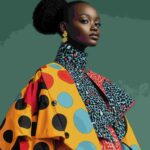

Wandia Gichuru left a career at the UN and the World Bank to build a fashion company in Nairobi in 2011. Fifteen years later, Vivo Fashion Group has more than 30 stores, a multi-brand e-commerce marketplace, a presence in Atlanta, and a Forbes 50 Over 50 Global listing. The story of how she got there is the story of how East African fashion grew up.

In a production facility in Nairobi, Wandia Gichuru is reviewing a sample. The garment on the table is not quite right, the seam allowance on the shoulder is off by a few millimetres, and the consequence, she explains to the pattern cutter standing beside her, is that it will not sit the way the design requires when worn by a woman who is moving rather than standing still. She is specific about this. She is specific about most things. The production meeting runs precisely to time, the decisions are made quickly, and the quality standard is stated clearly and without apology. By the time she moves to her next meeting, the correction has been noted, the timeline for resampling has been agreed, and the facility has returned to the rhythm of a working day.
This is not the Wandia Gichuru that the Forbes 50 Over 50 profile described, or the one who features in lists of Africa’s most inspiring women entrepreneurs. That version of the story is true and it is well-told elsewhere. The Wandia Gichuru in the production facility is something more commercially specific: a founder who has spent fifteen years learning, systematically and without shortcut, what it actually takes to build a fashion retail business at scale in East Africa. The knowledge she has accumulated about production, about consumer behaviour, about the logistics and financing and operational discipline that separate fashion brands that grow from fashion brands that plateau is the asset that the Vivo Fashion Group is built on. The stores and the brands are the visible output. The knowledge is the competitive advantage.
The Founding Insight
Vivo Fashion Group launched in 2011 as what Gichuru has described as a niche activewear concept. The founding premise was not primarily about activewear, however. It was about a gap in the Nairobi market that Gichuru had identified through the specific lens of her own consumer experience: the absence of well-designed, well-made, locally produced clothing for the East African professional woman.
The Nairobi fashion market of 2011 was bifurcated in a way that Gichuru found commercially illogical. At one end, imported fast fashion, low quality, generic, not designed for the specific body proportions and style preferences of East African women. At the other end, bespoke tailoring , high quality but expensive, slow, and inaccessible to the growing segment of professional women who did not have the time to manage the tailoring relationship. In the middle, a gap. Good quality, well-designed, ready-to-wear clothing that was actually made for East African women, by people who understood them.
Her previous career made this gap legible to her in ways it might not have been otherwise. Years working in international development at the UN, at the World Bank, had given her two things that proved invaluable. The first was a rigorous analytical framework: the habit of identifying a problem precisely, mapping its dimensions, and thinking systematically about how to address it. The second was international exposure to markets where the fashion retail infrastructure that Nairobi lacked had already been built and the commercial understanding, derived from watching it operate at close range, of what building it would require.
She did not approach Vivo Fashion Group as a passion project or a creative endeavour. She approached it as a business problem with a specific solution. That clarity of framing, maintained consistently through fifteen years of the ordinary difficulties of building a company, is visible in everything Vivo does.
Building the Brand Portfolio
Vivo Fashion Group today encompasses multiple distinct brands, each serving a different consumer segment within the same broader market. Vivo Woman is the core brand, contemporary, professional, designed for the East African professional woman that Gichuru identified as her primary consumer from the beginning. Safari addresses the intersection of African aesthetic tradition and contemporary design. Zoya extends the portfolio into a younger, more accessible positioning.
The multi-brand architecture is not accidental. It reflects a deliberate strategy of serving the East African fashion consumer across her full wardrobe lifecycle rather than only at one price point or occasion type. A consumer who buys her work clothes from Vivo Woman and her weekend wear from another brand in the group is a more commercially valuable customer than one who buys from Vivo Woman for work and from an international fast fashion brand for everything else. The portfolio structure captures more of her spending and builds a consumer relationship that is more durable than any single brand occasion could sustain.
The “Made in Kenya” commitment that underpins all of it is simultaneously a values statement and a business strategy. Locally produced clothing gives Gichuru control over quality in ways that imported stock cannot, she can manage the production process directly, iterate on designs based on consumer feedback with a speed that international sourcing cannot match, and respond to demand signals in the market faster than a brand dependent on international supply chains. It is also, in a market where consumer attitudes toward locally made goods have shifted significantly over the last decade, a genuine commercial differentiator. The consumer who chooses Vivo because it is Kenyan-made is making a values-aligned purchasing decision that is stickier than price-driven loyalty.
The E-Commerce Expansion: Shop Zetu
In 2020, at a moment when the pandemic had forced a fundamental rethink of retail economics across the industry, Gichuru launched Shop Zetu, a multi-brand e-commerce marketplace focused on East African fashion brands. The timing was, in retrospect, exactly right: the pandemic had accelerated African consumer comfort with online retail, the competitive field of established e-commerce fashion platforms in East Africa was thin, and Gichuru’s existing production and logistics infrastructure gave her operational advantages that a purely digital startup would have taken years to build.
Shop Zetu has since won the Kenyan E-Commerce Fashion Award multiple time, a recognition that reflects both the platform’s commercial quality and its positioning within the market. It operates not simply as a channel for Vivo’s own brands but as a marketplace that aggregates other East African fashion brands alongside them. This is a strategically significant choice: it means that Shop Zetu’s commercial success is not limited by the performance of Vivo’s own product portfolio, and it positions the platform as infrastructure for the East African fashion ecosystem rather than simply a distribution channel for one brand.

The marketplace model also gives Gichuru visibility into the East African fashion market that would be difficult to acquire through any other means. The brands that perform well on Shop Zetu, the product categories that convert at the highest rates, the consumer behaviour patterns that emerge across a multi-brand browsing and purchasing environment, this is market intelligence that Vivo Fashion Group can deploy in its own product and retail strategy with a specificity and currency that competitors operating through physical retail alone cannot match.
The Expansion Beyond Nairobi
Vivo Fashion Group’s expansion beyond Kenya is among the most commercially significant things Gichuru has done and among the most underanalysed. Building a retail business across multiple East African markets requires solving problems that are simultaneously logistical, regulatory, financial, and cultural. Each market has different import regulations, different consumer aesthetics, different retail infrastructure, and different competitive dynamics. The operational complexity of maintaining quality and brand consistency across a multi-country retail footprint while managing the production economics that locally made clothing requires is not trivial.
The Atlanta, Georgia presence is, in the context of this expansion, particularly revealing. Atlanta has one of the largest East African diaspora communities in the United States, a consumer base that is simultaneously deeply connected to East African aesthetic identity and capable of sustaining the premium price points that American retail costs require. The presence in Atlanta is not a random international expansion move. It is a precise identification of a diaspora consumer market whose demographic and purchasing power characteristics make it a commercially viable extension of the East African retail model.
Gichuru has spoken publicly about the importance of proving that African fashion can be commercially serious not just culturally significant or aesthetically compelling, but operationally disciplined and financially viable at the scale that institutional investors and international retail partners require. The Atlanta expansion is part of that proof. A Nairobi-headquartered fashion group with more than 30 stores, a profitable e-commerce marketplace, and a commercial presence in the United States is a categorically different kind of company from a celebrated local brand. It is the kind of company whose business model can be studied, replicated, and invested in.
The Challenges That Remain
Honesty about the Vivo Fashion Group story requires acknowledging the challenges that the company continues to navigate challenges that Gichuru has been publicly candid about rather than obscuring behind the achievement narrative.
The production economics of locally made fashion in East Africa remain challenging. The cost of Kenyan fabric, labour, and production overhead means that Vivo’s price points must be set at a level that reflects genuine quality, a level that is higher than the international fast fashion alternatives available to its consumers. Maintaining the consumer’s willingness to pay the premium that locally made requires, in a market where international fast fashion is becoming increasingly accessible and increasingly affordable, is an ongoing commercial discipline rather than a resolved competitive position.
The logistics of multi-country retail, managing inventory across more than 30 stores in multiple markets, maintaining the supply chain connections that locally produced clothing depends on, and building the e-commerce fulfillment infrastructure that Shop Zetu requires to operate at commercial quality are complex and expensive. The operational burden of the model is significantly higher than that of a brand that sources internationally and manages a simpler, more centralised supply chain.
And the financing of expansion, the capital required to open stores in new markets, to invest in e-commerce infrastructure, to develop new brand lines within the portfolio is a constant constraint in an environment where African fashion businesses remain underserved by institutional capital. Gichuru has built Vivo Fashion Group to the scale it has reached without the kind of institutional investment that would have been available to a founder building an equivalent business in a more mature market. The discipline that constraint has imposed is part of what has made the business commercially serious. It is also part of what has made the growth slower than the market opportunity would theoretically support.

The Model and What It Means
The most important thing about the Vivo Fashion Group story is not Wandia Gichuru’s individual achievement significant as that is. It is what the model she has built demonstrates about what is possible in East African fashion when it is approached with operational rigour, long-term horizon, and a willingness to solve the unsexy problems of production, logistics, and consumer trust alongside the more visible work of design and brand building.
The multi-brand, multi-market, production-integrated, e-commerce-enabled fashion retail model that Vivo Fashion Group represents is the architecture that East African fashion’s commercial next phase needs to produce. It is not the only model, single-brand international exporters, direct-to-consumer digital brands, and designer studios with high-end retail will all play roles in the ecosystem. But it is the model that serves the largest segment of the East African fashion consumer, that creates the most local employment, and that has the most direct claim to the “Made in Africa” positioning that the global market is increasingly prepared to pay a premium for.
What Gichuru has proved, over fifteen years and more than 30 stores and a Forbes listing, is that the model works. That is a different and more valuable kind of proof than the creative recognition that African fashion has accumulated in abundance. It is proof of commercial viability and it is the proof that investors, policymakers, and the next generation of East African fashion entrepreneurs need most.
Wandia Gichuru has built the business that African fashion has been arguing it could build for a decade. Vivo Fashion Group’s combination of local production, multi-brand portfolio, e-commerce marketplace, and multi-market retail expansion is the architecture that East African fashion’s commercial maturity looks like. The Forbes 50 Over 50 recognition is appropriate not as validation of potential, but as recognition of achievement. The next chapter of East African fashion business will be written by founders who study this model carefully and build on it. FBA will be reporting on both.